 ADIE CYBERSECURITY REVALIDATED81 / 81 PASS47 / 47 EVIDENCE INTEGRITYIDENTITY · ISOLATION · AUDITVIEW SECURITY →
VALIDATION CENTER / HILLSTROM RANDOMIZED RETAIL EXPERIMENT
CLAIMS SHOULD LEAVE EVIDENCE.
ADIE validation using a public historical randomized marketing experiment containing 64,000 customer records.
8 / 8VALIDATION GATES
PASSED
PASSED
H1 / PASS
FROZEN EVIDENCE
Dataset integrity and experimental setup established.
CLAIM
The source supports a randomized marketing experiment suitable for the defined validation.
METHOD
Validate source identity, experimental structure and the evidence boundary before downstream analysis.
EVIDENCE
64,000 customer records from the Hillstrom randomized retail e-mail experiment.
RESULT
Dataset integrity and experimental setup: PASS.
LIMITATION
This establishes the Hillstrom validation setup; it does not establish performance in another company, domain or time period.
CAUSAL EVIDENCE
Randomized treatment effects recovered.
Identification: randomized assignment. Estimator: randomized difference in means with Welch standard errors. Independent reference maximum error for recovered treatment effects: 0.0.
Unsupported personalization was not promoted.
The individualized candidate did not demonstrate incremental value. ADIE retained the frozen global Men's E-Mail fallback, which remained positive on the untouched 12,788-record holdout.
12,788 PREVIOUSLY UNSEEN RECORDS
Positive gross-revenue effect on holdout.
$0.9694gross incremental revenue / customer
95% interval: $0.3543 to $1.5845. This is not a net-profit estimate.
Frozen and hash-verifiable evidence.
VALIDATION8 / 8 PASS
REGRESSION2719 / 2719 PASS
FAILURES0
RUNTIME488.89 s
DATASET SHA-256
0E5893329D8B93CE...C7284F291AECECOMPUTATION SHA-256
05799A4376E4C62D...F41FEB7F7ED39B0
RESPONSIBLE CLAIM BOUNDARY
What this validation supports — and what it does not.
Recovery of randomized aggregate treatment effects
Treatment discrimination with multiplicity control
Safe rejection of one unsupported personalization candidate
Frozen fallback generalization to the reserved Hillstrom partition
Bounded gross-revenue sensitivity scenarios
Deterministic, hash-verifiable evidence artifacts
Universal causal accuracy
Performance on arbitrary interventions or domains
General individualized decisioning performance
Future-company or future-period generalization
Audited net profit or realized customer ROI
Independent certification or production readiness
PUBLIC EVIDENCE / FILES & PROVENANCE
OPEN ORIGINAL EVIDENCE: H3 - Causal Effects | H4 - Treatment Discrimination | H5 - Decision Safety | H6 - Holdout | H7 - Business Value
Open the H3-H7 JSON artifacts through the gate selector above. Their SHA-256 checksums were checked against the recorded H8 manifest before publication. The H8 manifest and freeze record are available for inspection.
The freeze record reports 8/8 gates, 88/88 validation tests and 2,719/2,719 regression tests passed (2 warnings; 488.89 seconds) on 15 September 2026. The complete original pytest execution log is not published. Hash matches establish consistency with recorded checksums, not computational correctness, independent auditing, external certification or production readiness. H1 and H2 have no separately published JSON artifacts. No raw dataset is redistributed.
SOURCE & ATTRIBUTION
Source data: Kevin Hillstrom / MineThatData - E-Mail Analytics and Data Mining Challenge, dated 2008-03-20. This is an independent ADIE validation and was not produced, sponsored or endorsed by Kevin Hillstrom or MineThatData. The raw source dataset is not redistributed here.
REAL-WORLD VALIDATION / INSPECTABLE EVIDENCE
HILLSTROM VALIDATION EVIDENCE
Inspect the available validation artifacts behind the reported results. The links open JSON files; they are supporting artifacts, not an independent certification. Review the files and any sensitive fields before publishing this website.
OPEN VALIDATION EVIDENCE 6 JSON ARTIFACTS ↓
Available validation outputs:
- H3 · Causal effects · JSON ↗
- H4 · Treatment discrimination · JSON ↗
- H5 · Individualized policy · JSON ↗
- H6 · Reserved generalization · JSON ↗
- H7 · Business value / ROI · JSON ↗
- H8 · Reproducibility manifest · JSON ↗
Reported test counts and holdout figures are displayed on the validation card. These artifacts do not by themselves establish independent verification or production readiness.
DECISION & SYSTEM TRUST / EVIDENCE-FIRST WALKTHROUGH
TWO QUESTIONS. ONE REVIEWABLE DECISION.
Explore the decision logic and the controls that protect it. This is an interactive explanation grounded in documented project evidence — not a live engine run or an independent security certification.
PUBLIC EVIDENCE VIEW
INTERNAL VALIDATION
INTERNAL VALIDATION
01 / 06EVIDENCE STATUS
Problem
WHAT IS SHOWN
BOUNDARY / WHAT IS NOT ESTABLISHED
DECISION TRUSTProblem → Evidence → Decision → Uncertainty → Verification → Business Impact
SYSTEM TRUSTIdentity → Authorization → Isolation → Integrity → Audit → Security Verification
Evidence boundary: Hillstrom supports the stated randomized marketing validation only. Security results are internal automated checks. This page does not assert universal performance, a completed independent penetration test, production readiness, or realized customer ROI.
USE CASES / DECISION ENVIRONMENTS
WHEN THE DECISION MATTERS MORE THAN THE PREDICTION.
ADIE is designed for decision environments where actions have consequences, uncertainty matters, and the path from evidence to action must remain explainable and auditable.
6POTENTIAL
APPLICATION AREAS
APPLICATION AREAS
APPLICATION SCOPE
The areas below are potential or designed-for applications. They are not claims of validated performance in these industries. Current real-world causal validation is the Hillstrom randomized retail experiment shown in the Validation Center.
USE CASE 01 / SUPPLY CHAIN DESIGNED APPLICATION
Respond to operational disruption with explicit trade-offs.
A shipment is delayed while fuel cost, congestion and customer impact are changing at the same time.
SIGNAL
Delay, fuel, route and service signals enter the decision context.
DECISION QUESTION
Should the operation hold, reroute, hedge, or combine interventions?
ADIE ROLE
Compare candidate actions causally, preserve uncertainty, enforce safety boundaries and expose the reasoning path.
VALUE TARGET
Reduce avoidable loss while keeping the chosen intervention explainable and reviewable.
EVIDENCE STATUS
Designed application area — not yet validated as a logistics performance claim.
COMMON DECISION PATTERN
Different industries. The same underlying decision problem.
One event can create several downstream decisions.
ADIE's architecture is suited to situations where the immediate event is only the start: downstream cost, customer impact, capacity and recovery choices may interact.
EVENTIMPACTOPTIONSVERIFY
Doing less can be the correct system behavior.
The Hillstrom validation demonstrated one important principle: an unsupported personalized strategy was not promoted. ADIE can preserve a safer fallback instead of forcing optimization.
UNSUPPORTED ≠ PROMOTED
Technical evidence should connect to measurable consequences.
Where the underlying data supports it, validated effects can be translated into bounded value scenarios with assumptions and limitations kept visible.
EVIDENCE → DECISION → VALUE
WHERE ADIE FITS
A useful ADIE problem has more than data.
Several plausible actions exist
Outcomes can be observed or estimated
Uncertainty changes the acceptable action
Constraints or safety boundaries matter
Decision reasoning must be auditable
Business or operational impact can be measured
ADIE does not make missing evidence appear
It does not guarantee causal identification from arbitrary data
It does not remove the need for domain constraints
It does not prove value before a domain-specific validation
It does not replace independent production assurance
High-stakes deployment still requires appropriate human governance
FROM POTENTIAL APPLICATION TO EVIDENCE
The correct next step for a new domain is not a broad performance claim. It is a scoped pilot: define the decision, baseline, measurable outcome, safety boundary and validation protocol before deployment.
CYBERSECURITY & TRUST CENTER / INTERNAL SECURITY VALIDATION
TRUST MUST SURVIVE THE DECISION PATH.
ADIE's security layer is designed around authenticated access, policy boundaries, tenant separation, auditability, integrity controls and fail-closed behavior.
1,475 / 1,475SECURITY SUITE
PASSED
PASSED
VIEW EVIDENCE 81 / 81 INTERNAL SECURITY REVALIDATION ↓
ADIE CYBER / SECURITY VERIFICATION81 / 81 PASS
Evidence-backed internal revalidation completed September 16, 2026. The 81 tests were reconstructed and run in separate fresh internal test executions; this does not establish that one historical 81-test run occurred.
60 / 60T8B–T8I primary suite
7 / 7T8J-A standalone
7 / 7T8H-C standalone
7 / 7T8I-C standalone
47 / 47Copied evidence files: SHA-256 match
Evidence custody: 47 files in a private consolidated audit package; checksum manifest and audit report retained offline. SHA-256 checks establish consistency of the copies with the recorded manifest, not independent attestation.
Scope: Internal security revalidation only. Not an independent penetration test, production security certification, or proof of production readiness. Raw internal evidence is not published on this page.
CONTROL 01 / AUTHENTICATION SECURITY BOUNDARY ACTIVE
Authenticated sessions are required at protected API boundaries.
BOUNDARY
Protected API access requires an authenticated session identifier.
CONTROL
Session validation is applied before protected operations proceed.
VERIFICATION
Invalid-session rejection has been exercised in internal security validation.
FAIL-CLOSED BEHAVIOR
Missing or invalid authentication does not silently become authorized access.
ASSURANCE SCOPE
This is internal prototype validation, not an external penetration-test certification.
DEFENSE IN DEPTH
Security is distributed across the decision system.
Identity is not authority.
Authentication establishes a session. Role controls then constrain what that session may do, while tenant context separates organizational scope.
Requests carry security context.
ADIE includes request-ID validation, configured origin controls, security headers and bounded request rates around authenticated API operations.
Security-relevant activity leaves evidence.
Request lifecycle events and audit records support investigation and verification rather than treating security as an invisible perimeter.
RESPONSIBLE SECURITY CLAIM
What the current evidence means.
Security-hardened enterprise prototype
Internally validated automated security controls
1,475 / 1,475 full security-suite tests passed
2,631 / 2,631 application + security baseline passed
81 / 81 T8B–T8J final security-gate tests passed
Zero detected security regressions at the recorded checkpoint
Independent external penetration testing
Production deployment hardening
Dependency and SBOM review
Production load and failure testing
Production key-management infrastructure
Independent audit / certification where required
ÏŸ
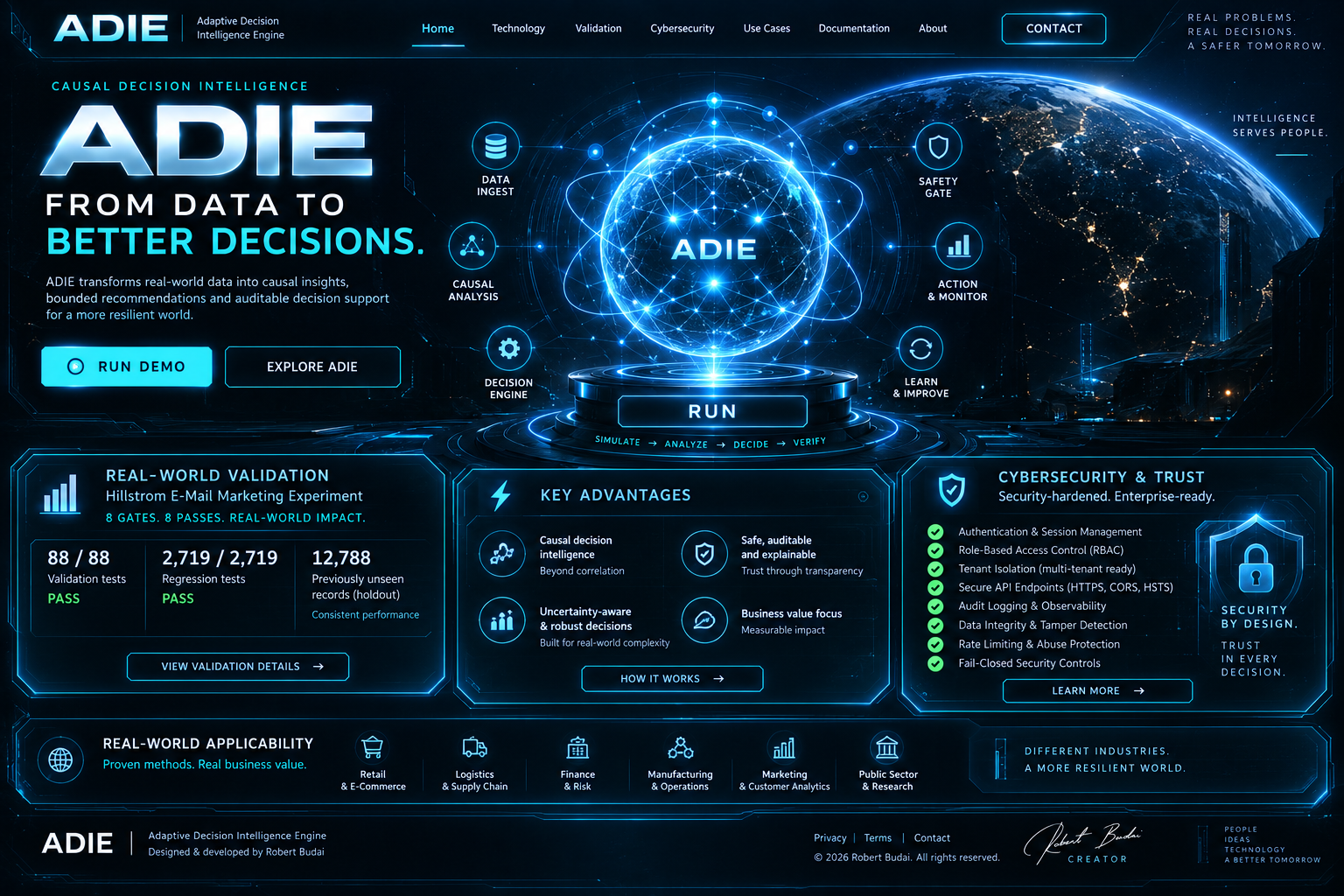
KEY ADVANTAGES
⌬
Causal decision
intelligenceBeyond correlation
◇
Safe, auditable
and explainableTrust through transparency
▥
Uncertainty-aware
& robust decisionsBuilt for real-world complexity
◎
Business value focusMeasurable impact
REAL-WORLD VALIDATION
Hillstrom E-Mail Marketing Experiment
8 GATES. 8 PASSES. REAL-WORLD IMPACT.
88 / 88Validation testsPASS
2,719 / 2,719Regression testsPASS
12,788Previously unseen
records (holdout)Consistent performance
records (holdout)Consistent performance
CYBERSECURITY & TRUST
Security-hardened enterprise prototype
- Authentication & Session Management
- Role-Based Access Control (RBAC)
- Tenant Isolation (multi-tenant ready)
- Secure API Endpoints (HTTPS, CORS, HSTS)
- Audit Logging & Observability
- Data Integrity & Tamper Detection
- Rate Limiting & Abuse Protection
- Fail-Closed Security Controls
TECHNOLOGY / HOW ADIE WORKS
FROM EVIDENCE TO A VERIFIED DECISION.
ADIE structures evidence, estimates causal effects, represents uncertainty and applies explicit safety boundaries before a decision is treated as actionable.
AUDITABLE DECISION PIPELINE
01
EVIDENCE
Real-world inputs are structured and validated before entering the decision process.
›
02
CAUSAL EFFECT
Estimate what changes because of an intervention — beyond simple correlation.
›
03
UNCERTAINTY
Confidence and uncertainty remain explicit inputs to the decision process.
›
04
DECISION
Candidate actions are evaluated against evidence, constraints and expected impact.
›
05
SAFETY / FALLBACK
Boundaries and fallback logic prevent unsupported confidence from becoming action.
›
06
HOLDOUT VERIFICATION
Performance can be checked against previously unseen evidence before promotion.
›
07
BUSINESS VALUE
Decision effects are translated into measurable operational or economic impact.
›
08
AUDIT TRAIL
Inputs, decision context and outcomes remain traceable for later review.
›
09
SECURITY
Authentication, authorization, isolation and integrity controls protect the decision path.
01 / EVIDENCE
INTERACTIVE ARCHITECTURE
Evidence enters before a recommendation does.
Real-world inputs are structured and validated before they enter the decision path. The purpose is to make the evidence boundary explicit and inspectable.
ROLEValidated input
BOUNDARYEvidence first
OUTPUTStructured context
Select any stage in the pipeline to inspect its role in the ADIE decision architecture.
Evidence before assumptions.
Every recommendation begins with evidence that can be inspected and validated.
Uncertainty is preserved.
ADIE keeps uncertainty visible instead of hiding it behind artificial confidence.
Trust requires verification.
Decisions remain auditable and bounded by explicit safety and verification controls.
ABOUT ADIE / SYSTEM IDENTITY
DECISION INTELLIGENCE BUILT AROUND EVIDENCE, RESTRAINT AND VERIFICATION.
ADIE — Adaptive Decision Intelligence Engine — is an independent decision-intelligence system designed to connect evidence, causal reasoning, uncertainty, safety boundaries, action selection and post-decision verification.
ADIEADAPTIVE DECISION
INTELLIGENCE ENGINE
INTELLIGENCE ENGINE
A decision should expose what supports it rather than hide behind a score.
Unknowns and weak evidence remain part of the decision instead of being silently erased.
When evidence does not justify an intervention, fallback or HOLD can be the stronger system behavior.
The reasoning path, outcome and security boundary should remain reviewable after the decision.
WHY ADIE EXISTS
More information does not automatically create a better decision.
Organizations can have data, models, dashboards and alerts while still lacking a clear answer to the question that matters: what action is actually supported now?
ADIE is built around that gap. Its architecture is intended to move from evidence to causal effect, uncertainty, candidate decisions, safety and fallback logic, holdout verification, business translation, auditability and security — without treating any one model output as unquestionable truth.
SYSTEMADIEDECISION CORE
EVIDENCE
CAUSAL
UNCERTAINTY
SAFETY
VERIFY
AUDIT
A decision-intelligence architecture.
ADIE structures the path from evidence to an actionable, constrained and reviewable decision. It combines decision logic with validation, auditability and built-in security boundaries.
Not a claim of autonomous certainty.
ADIE does not turn missing evidence into facts, remove uncertainty by declaration, or make every domain automatically validated. Domain-specific evidence and appropriate human governance still matter.
Validation and security are separated from marketing claims.
The public evidence presented on this site distinguishes the Hillstrom real-world causal validation from internal cybersecurity validation and from potential future application areas.
CREATOR / SYSTEM DESIGNRB
Robert Budai
Creator · Designer · Developer of ADIEADIE is an independently developed system project. The architecture, prototype direction, validation program and product concept are being developed around one central objective: make consequential decisions more evidence-aware, explainable, restrained and verifiable.
DESIGNED & DEVELOPED BY
Robert Budai
ADIE / 2026
DEVELOPMENT POSITION
Prototype evidence today. Production assurance is a separate step.
Adaptive decision-intelligence architecture
Real-world Hillstrom causal validation evidence
Internal automated cybersecurity validation
Auditable and reproducible evidence approach
Interactive enterprise product prototype
Additional domain-specific validation
Scoped enterprise pilot
Independent penetration testing
Production infrastructure and monitoring
Operational SLA and deployment assurance
ADIE / ADAPTIVE DECISION INTELLIGENCE ENGINE
Built to make the path to a decision visible.
INDEPENDENTLY DEVELOPED2026
DOCUMENTATION / SYSTEM MAP
UNDERSTAND THE SYSTEM BEFORE YOU TRUST THE OUTPUT.
This public documentation map connects ADIE's architecture, validation evidence, security position and application boundaries. Detailed internal implementation material remains separate from the public site.
01Technology ArchitectureEvidence → causal effect → uncertainty → decision → verification.
02Validation EvidenceHillstrom gates, holdout evidence, reproducibility and claim boundaries.
03Security & TrustAuthentication, authorization, isolation, auditability and fail-closed controls.
04Application BoundariesPotential decision environments and the evidence required before domain claims.
PUBLIC DOCUMENTATION STATUS
The website summarizes verified project evidence and architecture. It is not a substitute for deployment documentation, API reference, security assessment reports or production runbooks.
◉Retail & E-Commerce
▣Logistics & Supply Chain
▥Finance & Risk
⚙Manufacturing & Operations
▤Marketing & Analytics
◇Public Sector & Research
CONTACT / DEVELOPMENT & ENTERPRISE INQUIRIES
START WITH THE DECISION PROBLEM.
Describe a concrete decision, the available evidence and what a successful outcome would mean. This is an inquiry, not a commitment to a pilot.
DEFINE → VALIDATE → EXPLORE A PILOT
ENTERPRISE INQUIRY / CONTACTSETUP REQUIRED